

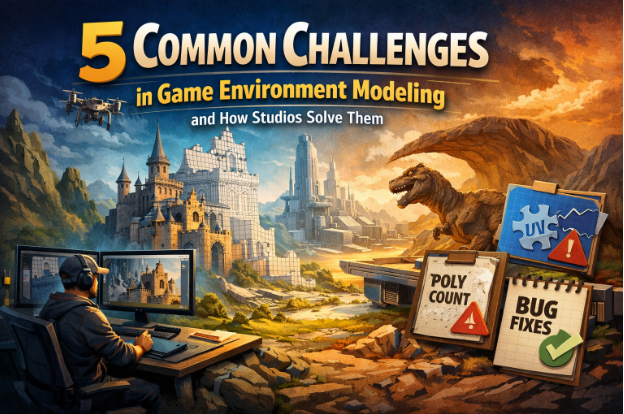

Building engrossing and quality game worlds is one of the toughest endeavors in the field of modern game development. Game worlds have to appear realistic, support gameplay, provide a visual narrative, and at the same time have to run in a smooth manner in real-time.
Game environment modeling is a field rife with difficulties, irrespective of the expertise of the developers working in this domain.
Here are five typical challenges studios may encounter when creating their environment, together with the effective methods the studios apply to tackle these challenges.
1. Balancing Visual Quality With Performance
The Challenge:
There is a desire for rich, realistic environments for players to engage with, but performance constraints exist when using real-time engines. Density and detail can easily lead to game crashes and slow loading screens.
How the studios resolve this issue:
Studios take into consideration the optimization of the environment from the very start of design.
Solutions include:
- Modular assets rather than custom geometry worldwide
- Level of Detail (LOD) Systems for Distant Objects
- Texture atlasing. Reducing draw calls.
- Substituting geometry with normal map detail
Thus, instead of treating optimization as an afterthought at the end of their process, they incorporate optimization as part of the creative process and ensure that quality is achieved without compromising on performance.
2. Consistency in Large Game Worlds
The challenge:
Open-world games and multi-level games may find dozens of artists working on multiple areas. If it lacks proper management, the levels can become inconsistent in terms of scale, material, or style.
How the studios address this problem:
- Consistency is enforced through:
- Style guides that are easy to follow
- Guidelines for references
- Shared Modular Asset Kits
- Standardized guidelines on material and lighting
- Art reviews and quality assessment
Many studios work alongside a 3D game art outsourcing studio that adheres to these same principles, so scaling can be achieved while creating a consistent visual style.
3. Aligning Environment Art with Game Play Needs
The challenge:
A scene may be beautiful yet feel irritating as a playing environment. Poor wayfinding, ambiguous routes, or crowded spaces may interfere with gameplay flow.
How studios do it:
Environment modeling is heavily linked to level design. The artists and designers start teaming up early through blockouts to test:
- Player movement and navigation
- Line of Sight and Visibility
- The line of sight
- Combat spaces & cover placement
- Exploration flow and pace
Detailing will be added after the game layouts are confirmed functional, with all environments being capable both for play and view.
4. Managing the Volume of Assets
The Challenge:
Modern games involve an enormous amount of assets in the environment—the buildings, terrain pieces, objects, trees, and scenery. It would be burdensome to create all these in-house.
How the studios handle the problem:
The studios use modularity and outsourcing to handle large sizes efficiently. A 3D game art outsourcing studio with professional expertise can:
- Create a large number of environment assets & props
- Follow existing art styles and technology limitations
- Provide optimized, engine-ready models
- Remove restrictions on internal teams working on core gameplay and world design
This ensures that the production process continues uninterrupted without jeopardizing quality.
5. Creating Realism Without Making Worlds Feel Repetitive
The challenge:
Repurposing modular resources is better in terms of speed and efficiency; on the other hand, too much repetition could result in dull environments.
Studios incorporate variability in the following ways:
- Several texture packs and material variants
- Removing dirt and wear
- Environmental decorations
- Minor Mesh Variation on Modular Pieces
- Strategic lighting and prop usage
These methods maintain efficiency while ensuring that each region sounds different and believable.
Why These Challenges Are Interconnected
There would be no challenge faced while modeling the game environment alone because the result of performance will impact graphics, consistency will impact immersion, and the result of gameplay alignment will affect the satisfaction of the players.
This is why studios today use pipelines, collaboration, and scalability to solve their problems, instead of doing things their own, non-scalable way.
The Role of Outsourcing in Overcoming Environmental Issues
Outsourcing is no longer simply an issue of cost; it’s also related to scalability, and it’s about being able to specialize. Working well, an outsourcing company for 3D game art can be considered an extension of an internal team at a studio, allowing it to:
- Manage massive content requirements
- Ensure consistent quality
- Embrace tight deadlines
- Adapt Quickly to Scope Changes
Communication and a strong pipeline are making this collaboration highly effective.
Conclusion
Creating immersive game worlds is an extremely complex process that requires multiple factors to be balanced effectively. Realism, support for game play, consistency, and perfect execution are the aims that must be achieved during very tight project timelines by game environment modeling processes.
Through using modular design, gameplay testing, maintaining strict style guidelines, optimization, and outsourcing, these challenges are successfully addressed. The outcome is a game environment that is rich, playable, and full of life—the type of world players will want to explore, remember, and return to.
In today’s world of competitive gaming, how game developers address these environment-related issues can be the deciding factor for a positive gaming experience overall.