

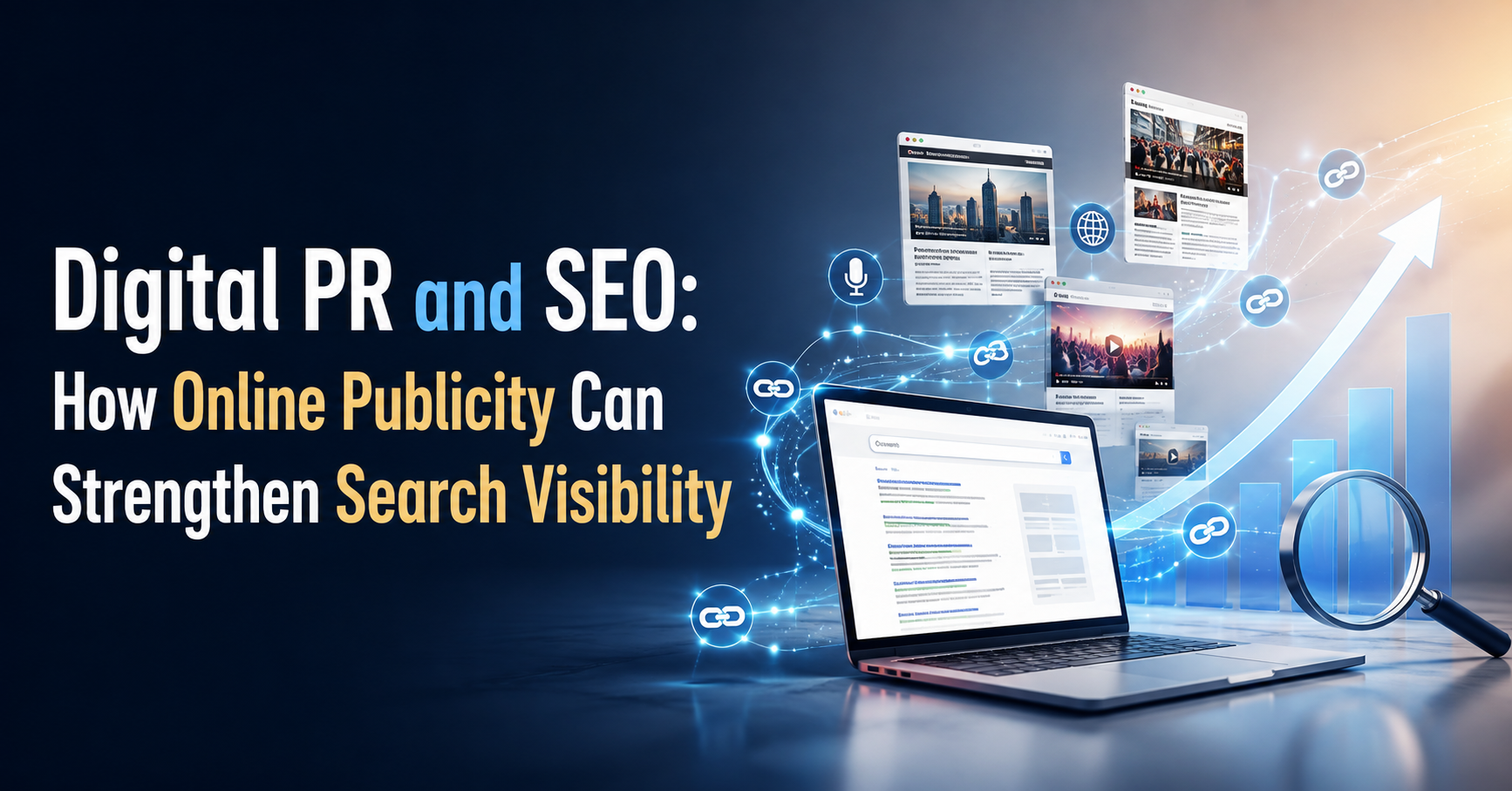

Ever notice how some websites outrank competitors with cleaner on-page SEO? Nine times out of ten, we find digital PR sitting somewhere in the background. A brand mention on a news site or an industry blog does more than get eyes on your name. It tells Google that outside publications vouch for you, and that carries real weight in how you rank. Here’s what we’ll walk through: what digital PR actually is, how it turns into backlinks and brand mentions Google can measure, why it matters for E-E-A-T, what it means for showing up in AI Overviews, and how local press can help an SEO Company in Chennai punch above its weight in local results. Read on and you’ll know exactly where PR fits into your search strategy, and where to start.
What digital PR actually means
Digital PR is getting your brand covered, quoted, or linked to from other websites. That could be a news outlet, a niche blog, a podcast, or a trade publication. Press releases fall under this. So do expert quotes, original data studies, guest posts, and the relationships you build with journalists over time.
Traditional PR wants awareness. Digital PR wants that too, but it chases something a search engine can actually count: links and mentions.
How digital PR strengthens your SEO
Google’s algorithm still cares a lot about what happens off your website, and PR touches a good chunk of those signals.
Start with backlinks. A link from a respected publication tells Google your site is worth citing, and it carries more weight than most link-building tactics precisely because nobody paid for it. Then there are brand mentions without a link at all. Google has said it can tie unlinked mentions back to your business, something people in the SEO world call implied linking.
There’s also the traffic itself. Someone who clicks through from a news article tends to stick around longer than someone who lands via a random search, and that behavior feeds back into how Google reads your site. We’ve also watched branded search volume climb after a good placement. People read about a brand, then Google it directly a day or two later, and rising branded searches read as a trust signal on Google’s end.
One more thing worth knowing: high-authority sites get crawled constantly. A link from one of them can get your new pages indexed faster than waiting on Google to find them organically.
None of this replaces solid technical SEO or well-written pages. It works next to that foundation, and honestly, it’s often the piece that pushes a site off page two and onto page one.
Why digital PR matters for E-E-A-T
Google’s quality guidelines run on Experience, Expertise, Authoritativeness, and Trustworthiness, shortened to E-E-A-T. PR feeds into most of these at once.
Get quoted as an expert source, and you’re building authoritativeness. Land coverage in an established outlet, and you’re borrowing some of their editorial credibility, because readers already trust that publication’s standards. Do this consistently, across a handful of credible sources, and you stop looking like a website asking to be ranked. You start looking like a name people already know.
Digital PR and AI Overviews
Search looks different than it did even two years ago. Google’s AI Overviews and similar AI-generated answers pull from sources they trust, and that trust runs on the same signals PR builds: citations, mentions spread across multiple credible sites, a consistent presence.
Picture two businesses with near-identical on-site SEO. One has been quoted in five relevant articles. The other has zero outside mentions. The first one has a real edge at showing up inside an AI-generated summary. That’s a big part of why PR moved from a nice extra to a core piece of any 2026 search strategy.
The local SEO angle
If you’re targeting one specific city, PR carries extra weight. Coverage in local news, trade associations, or city blogs strengthens the local relevance signals that matter for map pack rankings and “near me” searches.
Run a business in Chennai? Getting featured in local business press, showing up at events that draw press coverage, or being quoted by a regional journalist can lift your visibility in local search meaningfully, especially alongside a well-maintained Google Business Profile and consistent citations.
How we build digital PR into SEO strategy
At infiniX360, PR isn’t a side project bolted onto an SEO plan. It’s part of the plan from day one.
In practice, we start by figuring out who actually covers your industry, which publications, which journalists, sometimes even which podcast hosts. Then we dig through your own data, your launches, whatever expertise you’ve got, and turn it into a story worth pitching. Not a press release nobody reads. We pitch editors directly with a hook worth their time, track which mentions turn into real backlinks, and report back on how those wins connect to rankings, referral traffic, and branded search growth over time.
We’ve run this playbook across more than 50 industries, and the pattern holds up: clients who combine PR with technical and content SEO see stronger rankings, and those rankings tend to stick around longer than ones built on link-building tactics alone.
Wrapping up
Digital PR won’t hand you an overnight ranking jump, and we’d be lying if we said otherwise. What it builds instead is durable: the kind of trust Google, and now AI search tools, keep rewarding long after a single campaign ends. Pair it with solid technical SEO and content, and you’ve got one of the clearest paths to visibility that actually lasts. If you’re looking into Digital Marketing Services in Chennai and want PR, content, and technical SEO working as one plan instead of three separate efforts, our team at infiniX360 is happy to walk you through what that would look like for your business.
Frequently asked questions
Is digital PR the same as link building?
Not quite. Link building is usually a direct, often manual, effort to get links placed. Digital PR earns links as a byproduct of real media coverage. It’s harder to scale, but readers and search engines both tend to trust it more.
How long before we see SEO results from digital PR?
You’ll usually spot the first signs within a month or two, maybe a spike in referral traffic, maybe more people googling your brand name directly. Actual ranking movement usually takes another two to four months, once Google picks up on the pattern.
Do unlinked brand mentions really help SEO?
Yes, and this one surprises people. Google has confirmed it can associate a brand mention with your business even without a hyperlink attached.
What kind of content actually gets picked up by journalists?
Original data and surveys work well. So does sharp expert commentary or a fast, well-timed reaction to industry news. A generic press release rarely gets a second look.
Is this worth it for a small or local business?
We’d say yes. Local and regional coverage often moves the needle on local rankings more than people expect, especially paired with a strong Google Business Profile.
How do we measure whether a PR campaign is working?
We look at backlinks earned, the authority of the referring domains, branded search volume, the quality of referral traffic, and eventually, keyword rankings.
Does any of this help with AI-generated search answers?
It does. AI Overviews and chatbot-style answers lean toward sources with consistent mentions across several credible platforms, which is exactly what a good PR campaign builds over months.